Get the trustworthy tools and support you need to move your targeted protein degradation (TPD) project forward. CST offers a comprehensive suite of platform-compatible, application-validated tools to answer critical questions at every stage of TPD drug development. And our in-house manufacturing means you can count on reliable supplies.
With an unmatched range of top-tier products backed by technical rigor, CST® solutions help reduce risks in assay implementation, increase data confidence, and improve productivity on platforms you already use.
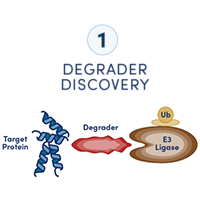

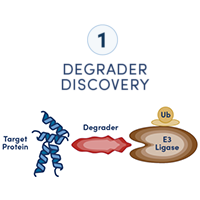
Optimize degrader design and identify the associated E3 ubiquitin ligase for your target molecule in cells or tissues of interest.
|
Experimental Goal |
Method |
CST Solutions |
|---|---|---|
| To measure abundance of E3 ubiquitin ligases in cells or tissue of interest |
Using specific antibodies to detect E3 ubiquitin ligases and their components |
|
| To discover accessible, nearby reactive residues on my protein of interest that can improve the binding of my degrader |
Reactive cysteine mapping/profiling using mass spectrometry |
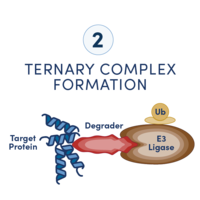
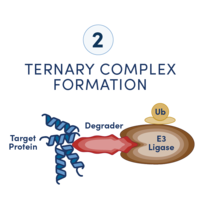
Investigate ternary complex formation with assays designed to demonstrate physical proximity between an E3 ligase and your target protein. Optimal ternary complex formation is essential for efficient ubiquitination of the protein of interest(POI) and UPS-mediated degradation.
|
Experimental Goal |
Method |
CST Solutions |
|---|---|---|
|
To confirm that the degrader forms a ternary complex with the E3 ligase and target protein |
TR-FRET immunoassays |
|
|
Pair-based immunoassay tools |
||
|
Biochemical assays |
||
|
Proximity labeling (TurboID/BioID) LC-MS |
||
|
To examine reactive cysteine residues on my target protein for covalent adduct formation of my degrader |
Reactive cysteine mapping/profiling LC-MS |
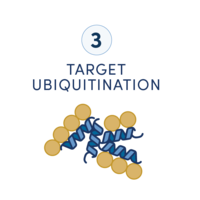
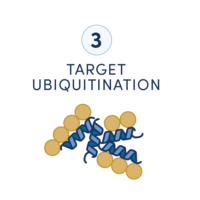
Confirm the ubiquitination of your target protein using ubiquitin antibodies, pan-branched ubiquitin profiling, Tandem Ubiquitin Binding Entities (TUBEs), or with a comprehensive view of all ubiquitination sites using LC-MS proteomics.
|
Experimental Goal |
Method |
CST Solutions |
|---|---|---|
|
To identify and quantify ubiquitination on my protein of interest |
LC-MS-based enrichment, identification, and quantification of ubiquitination |
|
|
Validated antibodies to specifically detect free or polyubiquitination |
||
|
Tandem Ubiquitin Binding Entities (TUBEs)-based profiling of pan ubiquitination |
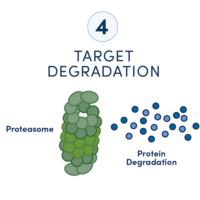
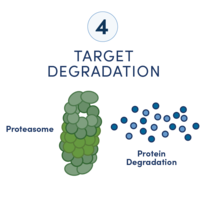
Evaluate the effectiveness of your degrader candidates by directly assaying the levels of your target protein after treatment using specific and sensitive antibodies. Or take advantage of deep proteome profiling offered by CST Proteomics Analytical Services.
|
Experimental Goal |
Method |
CST Solutions |
|---|---|---|
|
To find out whether the protein of interest has been degraded |
Simple |
|
|
ELISA |
||
|
High-Content Imaging, Analysis, and Screening (HCI/HCA/HCS) |
||
|
Antibody conjugates |
||
| Deep proteome profiling using DIA Mass Spectrometry |
Obtain a broad molecular understanding of the on- and off-target effects of your TPD molecule using LC-MS proteomics.
|
Experimental Goal |
Method |
CST Solutions |
|---|---|---|
|
To examine on- and off-target effects of a specific degrader |
Monitor on- and off-target protein degradation |
|
|
Identify and quantify sites of ubiquitination for on- and off-target validation |
||
|
Survey downstream effects of TPD dosing |
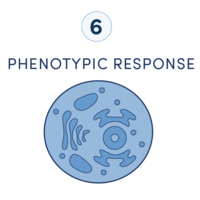
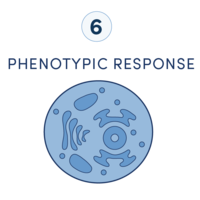
Examine the resulting cellular morphology and protein localization of targets along with different cellular and tissue-based phenotypic readouts and markers.
|
Experimental Goal |
Phenotypic Markers and Readouts |
|---|---|
|
Downstream cellular and tissue-based phenotypic changes after degrader treatment |
Targeted protein degradation is a versatile therapeutic approach that uses the cell’s own destructive machinery to degrade proteins of interest (disease drivers). TPD is attractive as a therapeutic modality because many proteins of interest lack features (e.g., binding pockets) that can be targeted by traditional small molecule therapies, rendering them “undruggable” by conventional methods. These platforms, along with other TPD modalities, can target previously undruggable proteins for degradation by inducing proximity-based interactions between the protein of interest and an effector molecule, opening the door to the potential development of targeted drug therapies for a wide range of diseases.
Common degrader molecule chemistries include: